
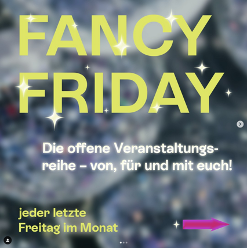
At the start of 2024, the youth-focused open space initiative “Fancy Friday” at JES Stuttgart entered a new phase with 3Place. In this handover phase Emilia Detering and Benni Bosler, two young adults, took the reins of curation and organization for the event series aimed at engaging young people.
Emilia and Benni embarked on a mission to understand the needs and desires of Stuttgart’s youth. They dove into youth centers and schools to gather fresh ideas and listened to what young people wanted to experience in their city. they had the power and freedom to plan events that they too had always wanted to experience in our theatre. They even took charge of designing everything for these events across the social media platforms.
The result of their research and brainstorming was a series of diverse and engaging Fancy Friday events.
January: Fancy Friday Goes Gossip and Crochet

Kicking off the year, around 30 attendees gathered for a cozy, laid-back evening. The event was centered around the theme of gossip and crochet, where participants indulged in watching trash TV, reading magazines, laughing about horoscopes, and og course knitting and crocheting.
February: Fancy Friday Goes Love Special

In February, love was in the air as about 35 attendees participated in an interactive evening dedicated to the topic of all topics: LOVE!
This event featured a nostalgic twist with a reenactment of the famous German TV show from the ’90s, “Herzblatt,” led by the drag artist Inge Ringle. The audience got the chance to play along, trying to find a new friend. The evening was filled with love songs, LipSync performances, and even spaces where attendees could write letters to express their feelings, and also space to vent their frustrations and heartbreak.
March: Fancy Friday Goes Disco

March brought a burst of youthful energy as Fancy Friday transformed into a disco night. A very young and still inexperienced DJ group, Chaos.Dico.Club, took center stage, bringing the beats to the theatre’s foyer. In collaboration with the mobile youth work network (local social workers from Stuttgart), the event created a safe and vibrant space for young people to dance, drink some lemonade, and just let loose, a space they otherwise don’t have.
April: Fancy Friday goes open choir

Fancy Friday introduced a fresh and exciting collaboration with the talented young musician, Svea Kirschmeier and launched an open choir that brought people together through the power of music. The choir’s focus was on singing queer anthems, creating a safe and empowering space for all participants. Under Svea’s expert guidance, the group quickly mastered the art of polyphonic singing.
May/June: Fancy Friday meets “About good and bad but probably mostly about the complicated mess in between”

In a mash-up of two 3Place projects, Fancy Friday asked how do the participants of the upcoming show “About good and bad …” imagine the perfect end to a performance? All the participants took an online survey, and the results of the survey were then used to organize the ultimate end-of-show party, tailored to the desires of the group. The evening featured everything the participants had mentioned: karaoke, games, dancing, and a delightful array of snacks.
July: Fancy Friday goes Sunny Saturday

As the Fancy Friday season drew to a close, it went out with a bang by transforming into a Sunny Saturday summer party. This event marked the end of a successful season with a day filled with creativity and music. In collaboration with the dynamic young art collective, “Die Trabanten,” participants were treated to DJ and Art-Print Workshops. These workshops offered valuable insights into the world of art and music, teaching attendees how to create art prints and embark on a career in DJing. The festivities continued into the evening, with a memorable concert hosted by the talented student band, Port.
The events were a big success, consistently drawing around fifty attendees to each Fancy Friday. This turnout demonstrated the power and effectiveness of peer-to-peer collaboration.
About the project
Fancy Friday was developed at Junges Ensemble Stuttgart as an open-space initiative and a long-term fieldwork within the 3Place project, exploring how peer-to-peer formats can support the theatre as a third place for young people.
The research question behind Fancy Friday was: How can a theatre function as a place young people choose to be, without a performance as the main reason for attending?
To investigate this, JES tested a recurring, free-format structure, intentionally detached from the traditional performance frame.
The first phase focused on co-defining content. Through a kick-off workshop, young people articulated what they wanted from the theatre as a social and creative space. Their proposals — ranging from open stages and karaoke to repair cafés, voguing classes and drag events — were documented and used directly as programming material.
The second phase examined safety, responsibility and trust. Open stage formats revealed the need for clear communication around values and boundaries in order to maintain inclusive, discrimination-free spaces. This led to the development of house rules and proactive dialogue with participants and performers.
In the third phase, Fancy Friday became a test case for shared ownership. Responsibility for curating and organising events was gradually handed over to young adults, including communication, technical coordination and artistic decisions. This shift revealed both the strengths and limits of delegation: while peer-led formats increased relevance and engagement, institutional knowledge did not automatically flow back into the organisation.
A key finding was that peer-to-peer creation strengthens young people’s sense of self-efficacy, but long-term third-place structures require sustained integration of young people into institutional processes. This insight directly informed JES’ decision to involve young people more permanently in its organisational structures and to develop new outreach formats beyond the theatre building.
What we learned
- A theatre can function as a third place when participation is not tied to performance or consumption, but to presence, time and social interaction.
- Peer-to-peer formats significantly increase relevance and engagement, but delegating responsibility alone is not enough — institutional structures must adapt to allow knowledge to flow both ways.
- Clear communication of values and boundaries is essential to maintain safe, inclusive spaces, especially in open formats such as open stages.
- Young people experience strong self-efficacy when trusted with real responsibility, not simulated participation.
- Third places require continuity over time; one-off events are not sufficient to build ownership and belonging.