-
Digital Workshop #7: Exploring Urban Gaps as Potential Third Places
How can overlooked or underused spaces in our cities become places for young people to gather, create and belong? In March 2025, Digital Camp #7 brought together participants from Oslo, Stuttgart and Hradec Králové for a shared exploration of urban “gaps” — and how performing arts can activate them as third places.
Urban gaps as a starting point for artistic thinking
Digital Camp #7 was organised by Junges Ensemble Stuttgart (JES) in collaboration with Stadtlücken, a Stuttgart-based non-profit association working with underutilised urban spaces. Stadtlücken operates at the intersection of design, urban development and civic engagement, with a strong focus on public space as a foundation for democratic coexistence.
The aim of the digital camp was to introduce participants to Stadtlücken’s methods and perspectives, and to encourage them to transfer these ideas into their own artistic and theatrical practices within the 3Place framework.
Preparing to see the city differently
Ahead of the workshop, participants were asked to identify a place in their own city where they would like to try something out — a space that felt unused, overlooked or full of untapped potential. They shared photos and locations on a common digital mural board, ensuring that the workshop was grounded in concrete, local examples from the outset.
When the workshop began, participants introduced themselves by naming their city and describing it in a single word. This simple exercise immediately opened up a comparative perspective between Oslo, Stuttgart and Hradec Králové, highlighting both differences and shared experiences of urban life.
From observation to analysis
Stadtlücken provided a theoretical introduction to their work, focusing on how to recognise urban gaps — not only in architecture, but also in social structures and everyday use of space. Participants were invited to reflect on questions such as: What spaces do we pass by without noticing? Who uses them, and who does not? What could they become?
The shared mural board then became a key working tool. Each participant presented the place they had chosen, explaining what drew their attention to it and why it felt meaningful or problematic.
Awareness: Sharpening the eye for empty spaces and gaps in architectural, urban and social space.
Making connections: How do other people from your own city experience their own urban space? And what are the differences between Oslo, Hradec Králové and Stuttgart?
Reflection: What characterizes your city for you? What do you like about it and what are you dissatisfied with?
Activate: How can you change, redesign or transform urban spaces?
Transfer: How can you transfer this to your own city and connect it to your
artistic practice?Imagining new third places
Following a collective vote, one location from each city was selected for deeper exploration:
- an abandoned shopping centre close to the theatre in Oslo
- a listed staircase at a church in Hradec Králové, often used informally by young people
- a dark passageway connecting a shopping street and a park in Stuttgart
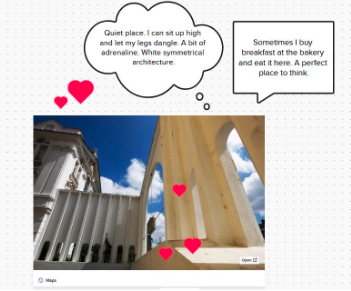
Participants then worked in groups to develop “desired images” for these spaces. Using collage, text and drawings, they explored how each location could function as a third place for young people, how it might connect to their local theatre, and how artistic interventions could transform its use and atmosphere.
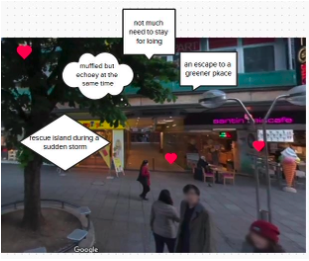
A key outcome was the exchange of perspectives between the participants from Oslo, Hradec Králové, and Stuttgart, fostering connections and a deeper understanding of public space dynamics. Through interactive discussions and a shared mural board, participants critically examined their cities and conceptualized creative transformations. Each group explored how their spaces could become engaging third places through artistic interventions.
Performing arts beyond the theatre building
The final presentations revealed a wide range of ideas, shaped by local context and participants’ own needs and experiences. Discussions focused on how theatre and performing arts can move beyond institutional buildings and engage directly with urban space — creating new forms of participation, visibility and belonging.
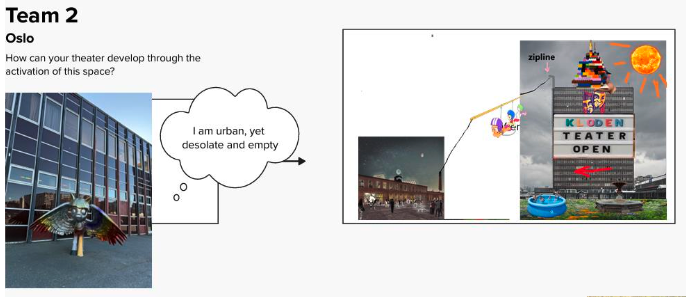
The final presentations showcased diverse ideas, demonstrating how theater
and the performing arts can extend into public spaces. The workshop effectively bridged urban studies and artistic practice, inspiring future projects that integrate creativity into city life. -
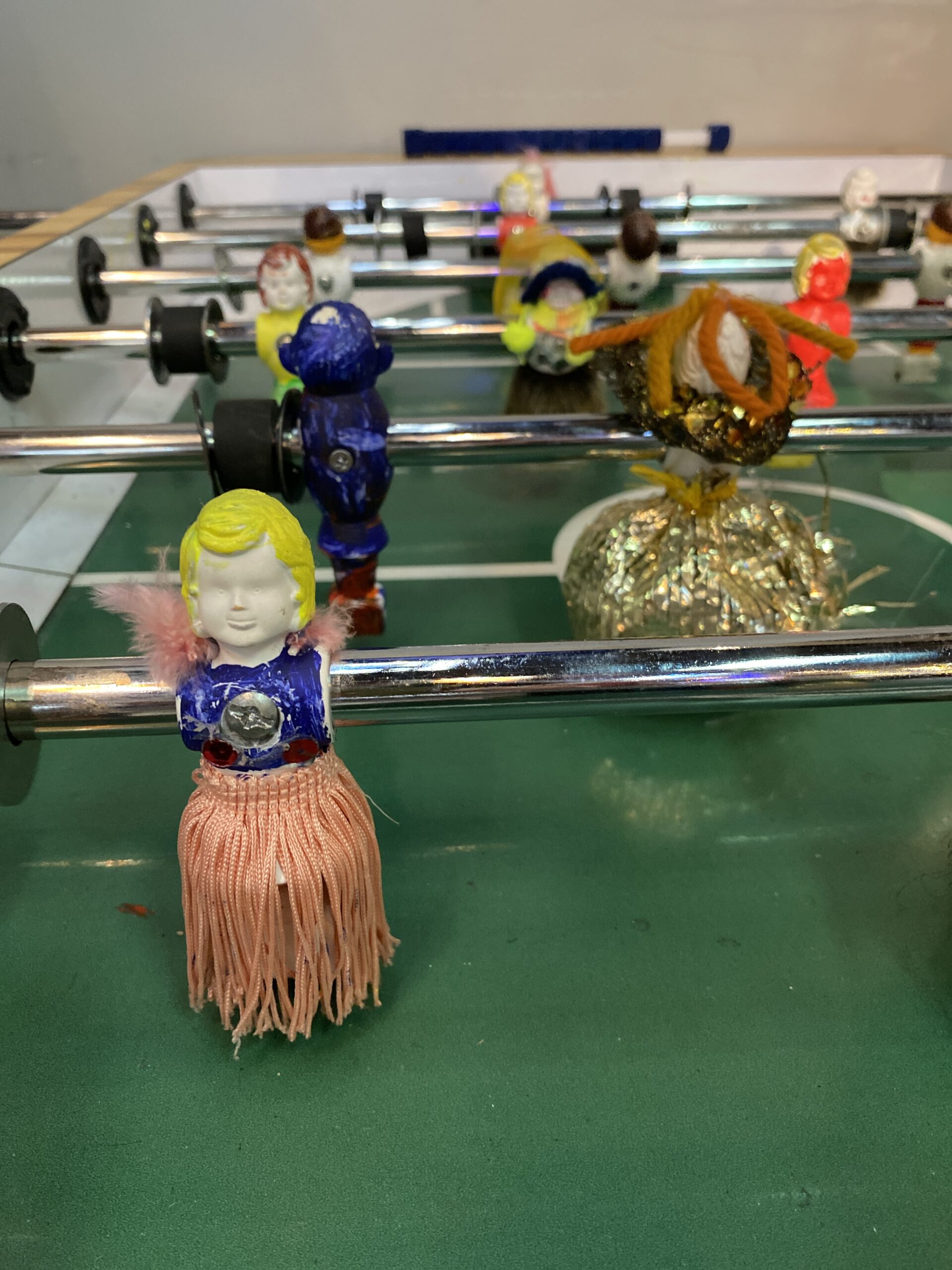
Video: Kuben Media students: what are third places?
Victoria and William talk about third places and how they define them. Can Kloden theatre and Scenekunstbruket make a real life discord in Kabelgata? Director: Lorent. Coordination and graphics: Josef. In front of camera: William and Victoria.
Sofus and Theodor discuss the limits and possibility of third spaces if the original idea is a digital space. What gives the ultimate escape from reality? Is it possible to build it as physical space? Could it be in Kabelgata? Should it be called 3Place, maybe? And how does it relate to Maslow’s hierarchy of needs? In front of camera: Sofus and Theodor.
Mahan og Leander discuss what role a third place can play in a persons social life, health benefits and how the concept has developed over time. Is it linked to identity and culture? In front of camera: Mahan and Leander.
Tobias tells us what a third place represent in today’s society: a feeling of belonging, somewhere to escape, enjoy the silence and a place to connect with others. Voiceover: Tobias.
-
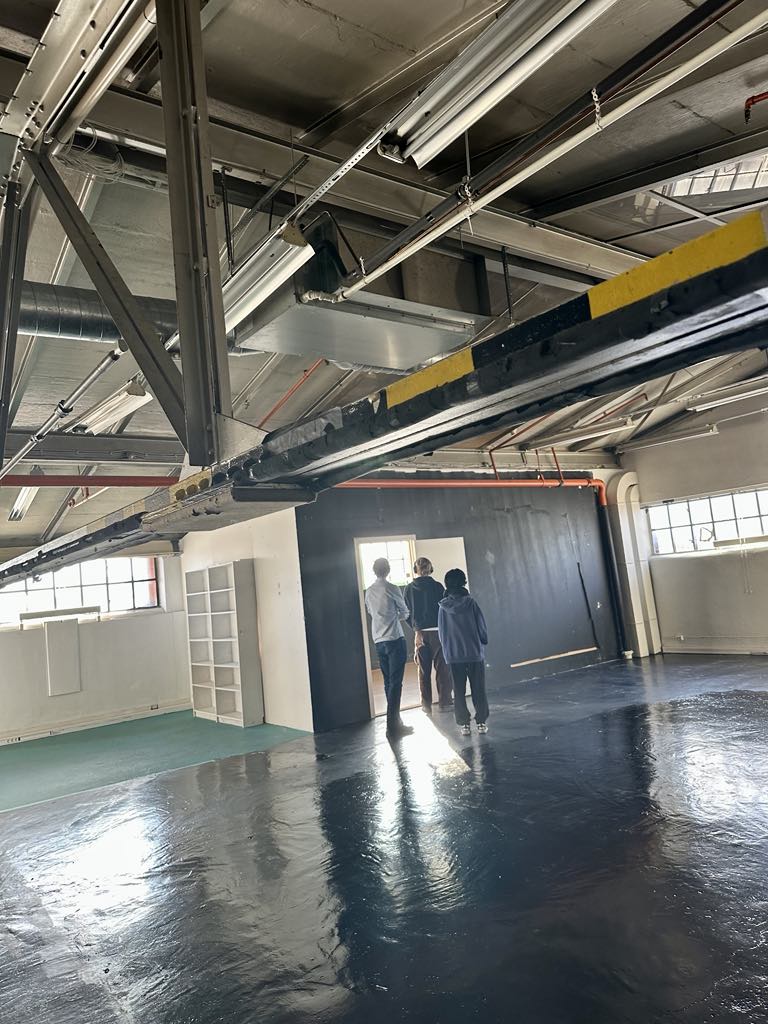
Fieldwork: The need for space
17-year-old Theodor, William, and Dominic, students at Kuben Upper Secondary School, recently completed a placement at Scenekunstbruket and Kloden Teater. During their time there, they worked extensively on creating films and interviews about upcoming performing arts productions. They also attended three different theater performances at three different venues in Oslo: Vega Scene, Det Norske Teatret, and Det Andre Teatret. In connection with the EU project 3Place, they discussed how a theater can become relevant to them and, with the construction of Kloden Teater underway, how they would like to be welcomed there. Their experiences varied, but they all walked away with strong impressions.
Theodor has always liked improvisation and was particularly excited about Maestro Impro at Det Andre Teatret. “I didn’t even know that improv was theater,” he said. “For me, it has always been more about entertainment.” He found the first performance they attended, Kvit norsk mann, to be very different from anything he had seen before, while Unlimited Voidwas “definitely SOMETHING – but I don’t know if there are words for it.”
William remembers Unlimited Void best, simply because it was “completely insane.” However, it was Kvit norsk mannthat left the biggest impression on him. “It addressed important and relevant topics in an engaging way. Something about it just sticks with you,” he explained. He was already familiar with the book the performance is based on, as his Norwegian teacher in middle school was a big fan. When it comes to theater in general, his experiences during the placement have made him more open-minded. “I’ve never been against theater, but I see it in a slightly different way now,” he said, though he found it difficult to pinpoint exactly what had changed.
For Dominic, this was not his first encounter with theater. He watched a lot as a child and had also attended performances with school before. “I’ve been to Det Norske Teatret before, and I really like it. The building is beautiful, the lobby is warm and inviting because of the lighting and all the wood – it just feels cozy,” he said. Unlimited Void made an impression, particularly because of the way it explored artificial intelligence and love. “Before the performance started, we wrote about what love meant to us in a book, and at first, I thought it was unrelated. But then it turned out to be exactly what the play was about,” he explained. He also felt that the presence of anime culture in the performance made sense. “Anime can take you out of the real world and give you a break – it felt right that the performance had that element.”
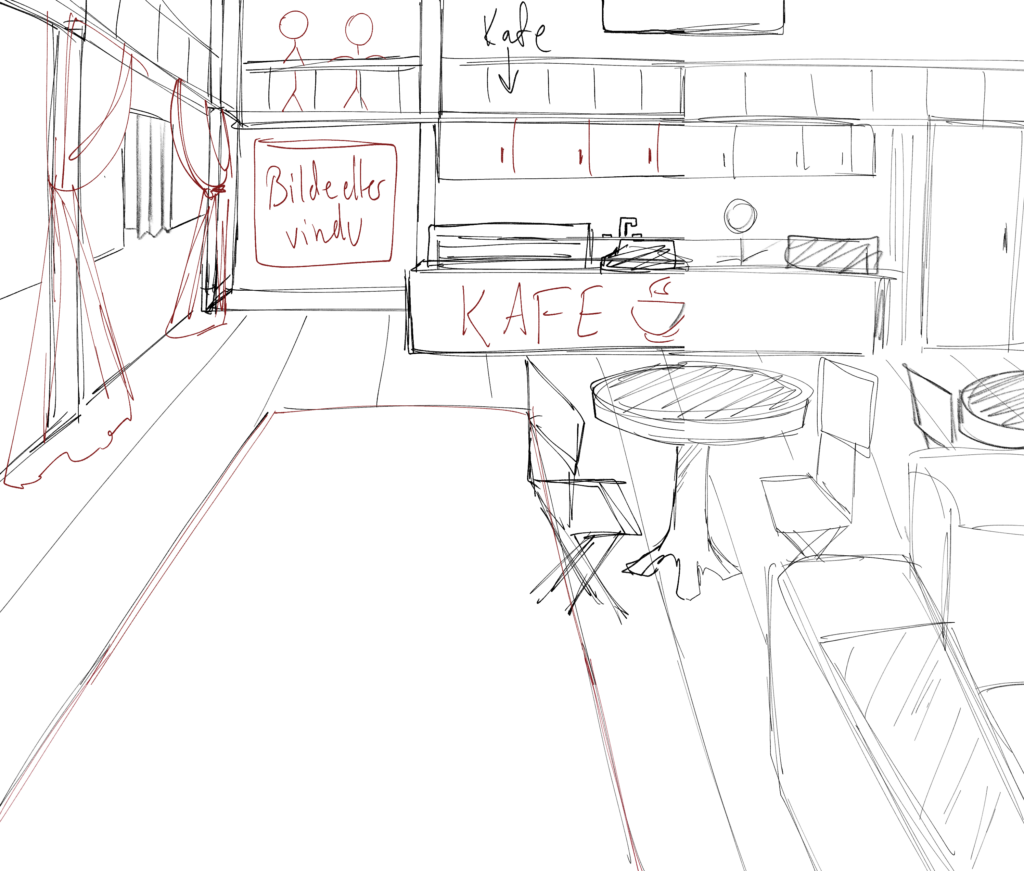
Dominic made a sketch of how he imagined the lobby and café area could look like at the future Kloden theater. He felt it was important that the seats and lounge area was visible from the outside, to give passers by a reason to go in. To make it warmer, cozier and with better acoustics he suggested to add a curtain seperating the café from the lobby and entrance area.
The theater buildings they visited also shaped their experiences. Theodor described Det Norske Teatret as “beautiful and fancy,” while Det Andre Teatret had a more relaxed and down-to-earth vibe. William liked the grandeur of Det Norske Teatret: “It feels classic and elegant,” he said, but added that Det Andre Teatret was still the coziest of them all. Dominic agreed that the atmosphere in theater buildings plays an important role. “For people to feel welcome in a theater, I think it has to feel homey,” he said, pointing out a challenge with the area around their school. “Kuben students often feel that Kuben is isolated. There’s nothing nearby – no places to buy food, nowhere to just hang out and have a good time. During breaks, we order food because there aren’t any other options.” The lack of quiet or private spaces at school also affects how students experience their daily lives. “People don’t really hang out in the library because it’s open and not quiet. There’s a long line in the cafeteria, and it’s really noisy upstairs in the library,” Dominic explained. He wishes for a place that feels more relaxed: “I would love some kind of cozy den. Something homely.”
Making theater a natural part of everyday life takes time. Theodor believes that a theater near the school will at first feel unfamiliar, but it’s about letting it grow into the environment. “People need to talk about it, get used to it,” he said. “Those who enter Kuben through the main entrance don’t see Kloden Teater – they don’t go that way. That’s something that needs to be solved.”
As their placement comes to an end, all three agree that it has been a great experience. They have seen theater in new ways and perhaps gained a broader perspective on what theater can be.