-
Fieldwork: Rethinking the format
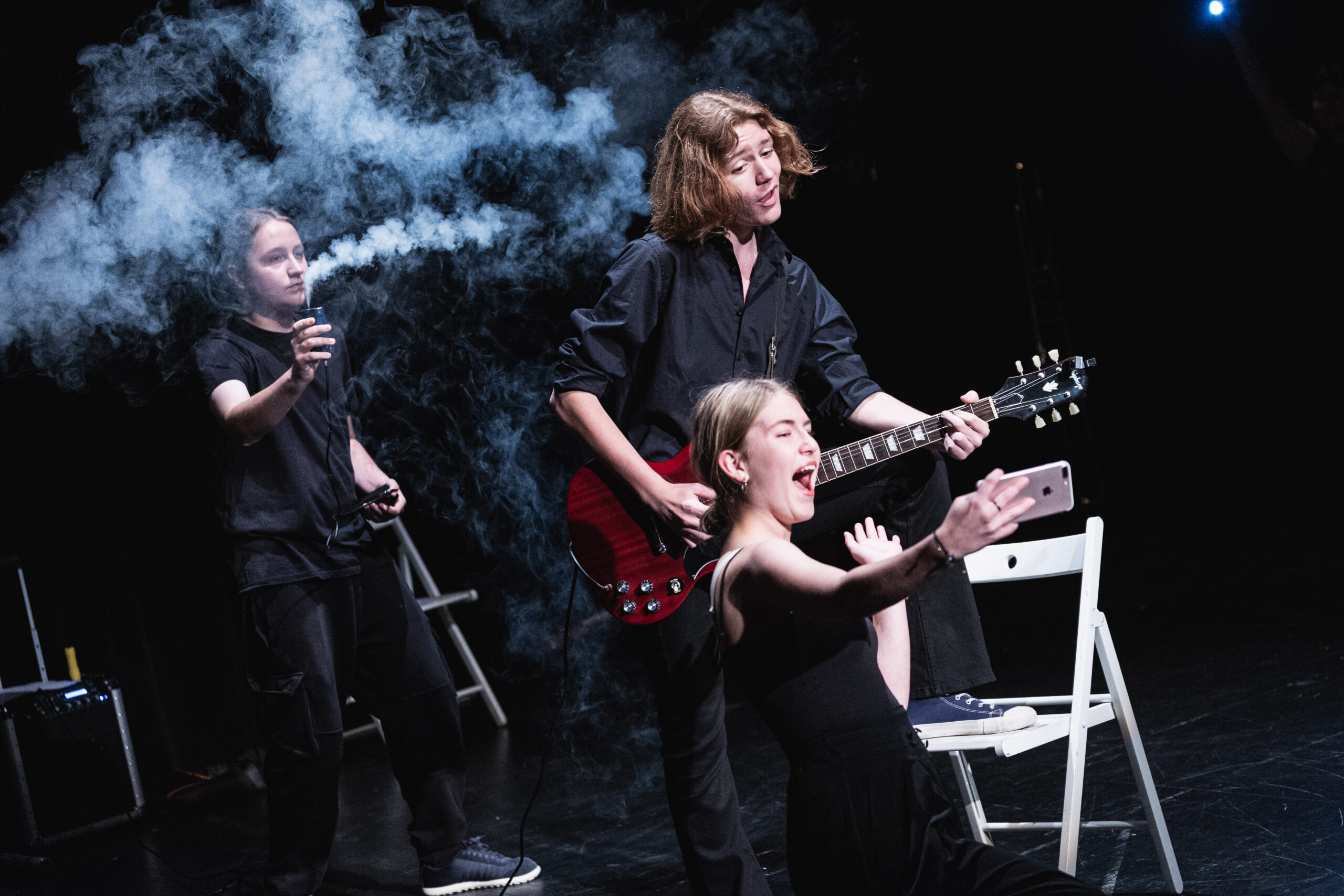
Drak Theatre previously ran two long-term youth ensembles (one for children, the other for teenagers), which met regularly once a week. These groups took part in a theatre education course that culminated at the end of each season in a work-in-progress presentation showcasing the results of the creative and educational process. Based on our positive experience with intensive creative work by teenage groups during the summer camps, and also inspired by how participatory creation with young people is approached at JES and in several other Czech theatres, we decided to transform the format for working with the teenage ensemble in 2025—or rather, to create an entirely new one.
We launched an open call, inviting teenagers to take part in the collective creation of an original production, led by Drak Theatre’s head educator Jana Nechvátalová and supported by members of the theatre’s artistic ensemble—professional actors Edita Dohnálková Valášek and Šimon Dohnálek. The creative process was structured into several weekend sessions, culminating in an intensive summer residency.
The result is the original production Míla D., inspired by the true story of a sixteen-year-old boy who escaped from a correctional facility and stole a bus. The production explores themes of freedom, resistance to the system, and the search for identity, and it draws not only from the original story but also from texts written by the teenage creators themselves.
The production has scheduled reruns and will be presented in the Drak Theatre studio. It is also planned to be presented at festivals dedicated to participatory work by young creators.
What we learned
- Project-based formats allow for deeper artistic engagement than weekly courses.
- Open calls attract participants ready for commitment and responsibility.
- Combining real stories with personal writing strengthens relevance and ownership.
- Long-term processes enable trust, complexity and artistic risk-taking.
-

Video: Artistic Co-Creation, Theatre as a Space for Ethical and Collective Inquiry
This fieldwork strand by Junges Ensemble Stuttgart investigated artistic co-creation as a third place, focusing on how collective artistic processes can support reflection, belonging and critical thinking among young adults.
Through an intensive kick-off weekend, young performers and professional artists explored methods of collective creation, authorship and responsibility. Rather than starting with a predefined concept, the group developed material from discussion, improvisation and shared inquiry.
The resulting production, about good and bad but probably mostly about the complicated mess inbetween, used the historical figure Boudica as a framework for examining moral ambiguity. The process deliberately avoided clear binaries and instead investigated contradiction, justification and ethical grey zones.
A key finding was that co-created artistic processes allow young participants to engage deeply with complexity, both intellectually and emotionally. The theatre rehearsal room became a third place for thinking together — not oriented towards answers, but towards shared questioning.
What we learned
- Artistic co-creation functions as a third place when the process prioritises collective inquiry over predefined outcomes.
- Young participants engage deeply with complexity when moral ambiguity is not simplified or resolved.
- Shared authorship strengthens responsibility and commitment to the artistic work.
- The rehearsal room can become a space for ethical reflection and belonging, not only artistic production.
- Trust in young people’s capacity to handle difficult questions leads to richer artistic material and stronger ownership.
-

Fieldwork: Using Youth Dialogue as Artistic Research
The production Metamorphosis (13+) at Drak Theatre was developed as part of the 3Place project through a process that deliberately integrated dialogue with young people as a form of artistic research. Rather than treating youth feedback as an add-on or evaluation tool, the creative team positioned it as a central element in shaping both the concept and the artistic language of the production.
A particularly important role in this process was played by Camp Artistic, held in Hradec Králové in autumn 2024. During the camp, Drak Theatre’s artistic team received detailed feedback from young participants from Norway, Germany and the Czech Republic on previous productions created for young audiences. These conversations focused not only on thematic relevance, but also on artistic means, performative strategies and modes of address.
At the same time, the camp created a space where young participants shared their own artistic work with one another. Through discussions and creative workshops, the Drak team gained insight into the themes, questions and aesthetic approaches that young people themselves find meaningful, urgent and representative.
From feedback to concept
Based on these exchanges, the artistic team began to explore how a well-known canonical text could be approached in a way that resonates with contemporary young audiences. Through a creative workshop with the camp participants, different strategies were tested for reworking familiar material without imposing a single interpretation.
These explorations led to the decision to develop an immersive, intimate production inspired by Franz Kafka’s The Metamorphosis, drawing not only on the novella itself, but also on Kafka’s personal correspondence with his sister and his father. Rather than treating the transformation of Gregor Samsa as a fixed metaphor, the production deliberately keeps its meaning open.
The central question guiding the work became: What does transformation mean today?
Is it a psychological state, a physical condition, a question of sexual orientation or gender identity, or a reflection of the unsettling changes associated with adolescence? Or is it something else entirely?Bringing the audience close
The production was conceived as a chamber piece for a limited number of spectators, employing principles of immersive theatre and live cinema. Audiences are invited into one extraordinary — or perhaps entirely ordinary — room, where they experience the story in close physical and emotional proximity to the protagonist.
Rather than explaining or resolving Gregor’s transformation, the production seeks to bring the audience as close as possible to his perspective. By sharing his confusion, isolation and sense of being misunderstood, young spectators are given space to connect the metaphor to their own experiences, uncertainties and fears.
Since its premiere in May 2025, Metamorphosis has been performed 23 times and seen by 1,050 audience members. An integral part of the production’s run has been regular post-show discussions with young audiences, focusing on the themes the performance opens up for them.
In addition, reflective workshops have been developed to accompany the production. These workshops support young audiences in exploring, naming and sharing their theatrical experience. Four such workshops have already been held, with unexpectedly strong engagement and feedback from participating high school students, who responded positively to both the form and content of the work.
To support teachers, Drak Theatre also offers Tune-in methodological support, based on a 3Place digital workshop connected to the themes of Metamorphosis. This material is freely available to educators planning to attend the production with their students.
- Dialogue with young people can function as artistic research, not only as feedback or evaluation.
- Youth perspectives help identify which themes and metaphors feel open, relevant and representative today.
- Leaving canonical material open to interpretation enables stronger personal identification.
- Immersive and intimate formats increase emotional engagement for young audiences.
- Combining performance with structured reflection deepens understanding and impact.
Metamorphosis demonstrates how sustained exchange with young people — across camps, workshops and performances — can meaningfully shape artistic processes and outcomes, and how theatre for young audiences can become a shared third place for reflection, identification and dialogue.